 Inked Mythos
Introduction to Cultural Tattoo Origins
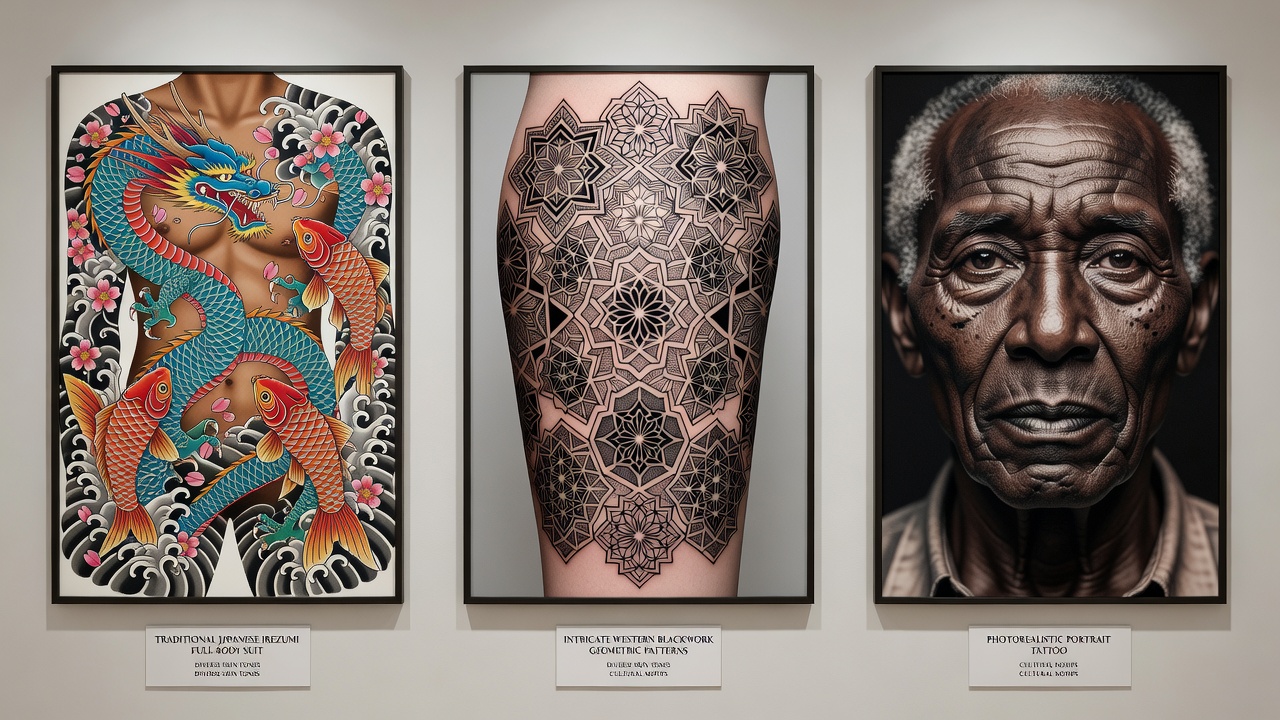
Tattooing carries profound cultural significance across civilizations, with styles like blackwork, realism, and irezumi emerging from distinct historical contexts. This exploration focuses on their heritage influences, timelines, and intersections rather than contemporary trends or application methods. Understanding these origins allows individuals to appreciate the depth behind each style and make informed choices that honor their roots in 2026.
Blackwork, realism, and irezumi represent three pillars of tattoo heritage. Irezumi stems from centuries of Japanese tradition, blackwork draws from European and indigenous geometric expressions, and realism evolved from fine art portraiture movements. Their stories reveal how body art has served as social marker, spiritual emblem, and artistic statement across eras.
Japanese Irezumi Traditions
Irezumi, meaning "inserting ink," traces its roots to Japan's Edo period (1603–1868). Initially used for marking criminals, it evolved into elaborate full-body suits symbolizing resilience and identity among laborers and outlaws. By the Meiji era, irezumi faced bans but persisted underground through secret networks of practitioners. Key motifs include dragons representing power, koi fish symbolizing perseverance, and peonies denoting bravery. These elements were chosen not for decoration alone but to convey personal narratives rooted in folklore and Buddhist teachings.
The style emphasizes bold outlines filled with dense color blocks, often covering large portions of the body in cohesive suits that tell continuous stories. Historical records show irezumi's transition from punitive marks to voluntary expressions of loyalty and endurance during the 18th century. Artists passed techniques through apprenticeships, preserving methods involving hand-poking with bamboo tools before the introduction of machines.
Artist Spotlight: Horiyoshi III
Horiyoshi III, a master of traditional irezumi, has preserved motifs like dragons and koi fish through decades of practice, emphasizing spiritual symbolism drawn from Buddhist and Shinto influences. His work demonstrates how irezumi continues to embody cultural continuity while adapting to individual client stories without diluting core meanings.
Western Blackwork Roots
Blackwork emerged in Europe during the Renaissance, influenced by woodblock prints and tribal markings. In the 20th century, it intersected with punk and alternative movements, drawing from geometric patterns in Celtic and Maori designs adapted for bold, solid black coverage. Early examples appear in sailor tattoos of the 1700s, where solid black bands marked voyages and achievements. The style prioritizes negative space and high-contrast fills, creating visual impact through repetition and symmetry.
Unlike the flowing narratives of irezumi, Western blackwork often features abstract or tribal-inspired patterns that emphasize strength and protection. Its evolution accelerated in post-war subcultures where it became a form of rebellion and group identity. Practitioners studied ancient Celtic knotwork and Pacific Islander designs to create original compositions that respected source aesthetics while fitting modern body placements.
Artist Spotlight: Manfred Kohrs
German tattooist Manfred Kohrs pioneered modern blackwork techniques in the 1970s, blending historical motifs with abstract forms to create dense, narrative pieces. His contributions helped formalize blackwork as a distinct Western tradition separate from Japanese influences.
Emergence of Realism from Portraiture
Realism tattoos developed in the late 19th century alongside photographic advancements and fine art portraiture. Artists transitioned from painting canvases to skin, capturing lifelike details inspired by European masters such as those in the Dutch Golden Age. The style relies on precise shading, color gradients, and anatomical accuracy to replicate photographs or paintings directly onto the body.
Early realism pioneers worked in port cities where global influences converged, allowing cross-pollination with other tattoo forms. The approach requires deep understanding of light, texture, and proportion, often demanding multiple sessions to achieve depth. Museums preserve examples of 19th-century tattoo flash that show the shift from simple line work to photorealistic rendering.
The Metropolitan Museum of Art holds collections illustrating how 19th-century portrait movements influenced early tattoo realism. Similarly, Britannica's entry on tattoo history provides timelines linking artistic movements to body art evolution. Additional context appears through Smithsonian resources on cultural artifacts.
Intersections and Shared Heritage
While distinct, these styles occasionally intersect when artists combine irezumi motifs with blackwork fills or realism shading. Such fusions require careful navigation to maintain respect for each origin. For instance, a dragon rendered in realistic detail within a blackwork frame must still honor the symbolic weight carried in traditional Japanese contexts.
Visual Comparisons of Authentic vs. Adapted Designs
Authentic irezumi features flowing lines and symbolic animals, while adapted versions simplify for smaller canvases. Blackwork often uses negative space in Western styles versus dense fills in traditional forms. Realism prioritizes shading gradients absent in pure blackwork. Consider a traditional koi fish: authentic versions show specific scale patterns and water flow tied to Japanese stories, whereas adapted designs may omit background elements or alter proportions for wrist placement. Blackwork tribal bands maintain strict symmetry in original Maori-inspired work but become asymmetrical in modern adaptations. Realism portraits demand exact likenesses drawn from source photographs, differing sharply from the stylized iconography of irezumi.
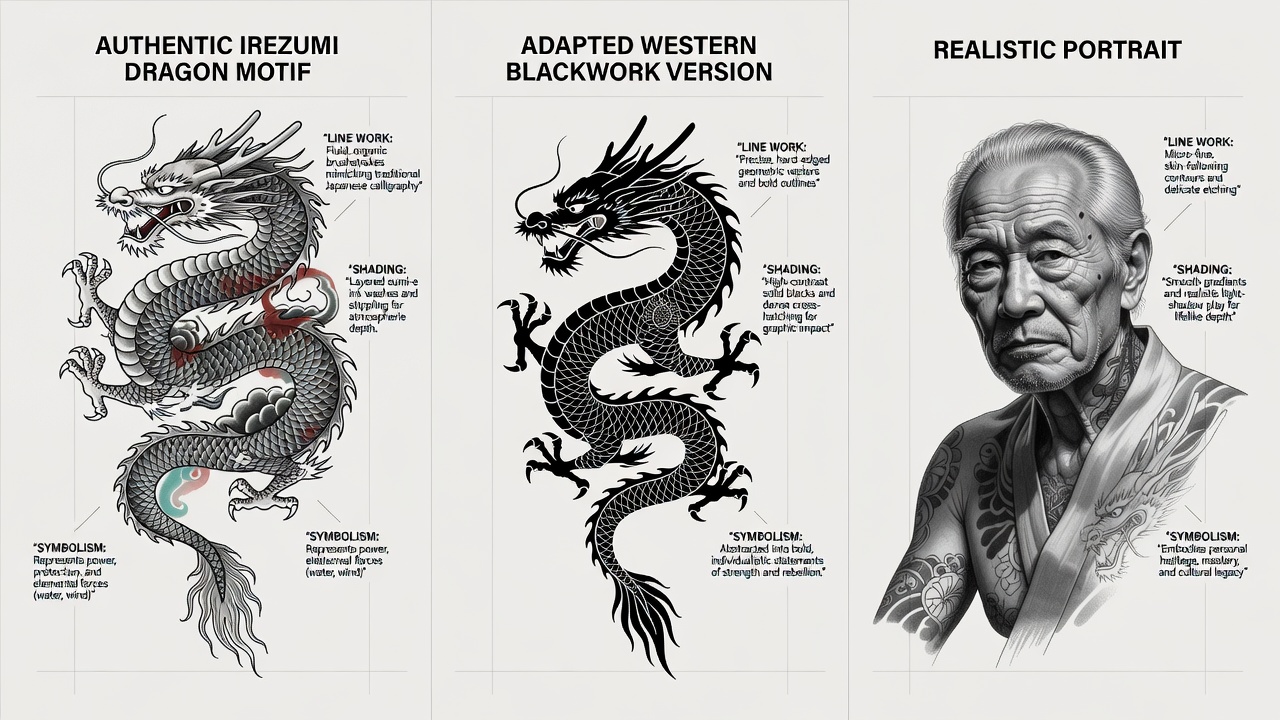
These differences highlight why studying primary cultural references prevents unintended dilution of meaning. Clients benefit from viewing museum archives and historical prints before finalizing designs.
Respectful Ways to Honor Origins in 2026
When selecting designs, research symbolism thoroughly and consult artists versed in cultural contexts. Avoid superficial appropriations by choosing pieces that respect original narratives, such as commissioning custom work informed by historical references. Practical steps include:
- Study primary sources from museum collections before choosing motifs.
- Discuss the story behind each element with the artist to ensure alignment with heritage intent.
- Opt for larger placements when possible to accommodate authentic proportions and details.
- Support practitioners who document their research into source cultures.
These approaches foster genuine appreciation rather than extraction of visual elements alone.
Short FAQ on Cultural Appreciation
Is it respectful to get an irezumi-inspired tattoo?
Yes, when done with understanding of its history and through collaboration with knowledgeable artists who explain motif significance.
How do blackwork and realism differ culturally?
Blackwork stems from bold, geometric Western and tribal roots, while realism draws from European portraiture traditions emphasizing lifelike representation.
What timeline marks key developments?
Irezumi formalized in the 1600s; blackwork surged in the 1900s; realism gained prominence post-1950s with photographic influences.
Conclusion
Exploring the cultural origins of blackwork, realism, and irezumi reveals rich layers of meaning that extend far beyond surface aesthetics. By engaging deeply with historical timelines, artist legacies, and respectful practices, individuals can select body art that truly honors these enduring traditions.
No comments yet. Be the first!