 Inked Mythos
Introduction: The Rise of AI in Tattoo Design
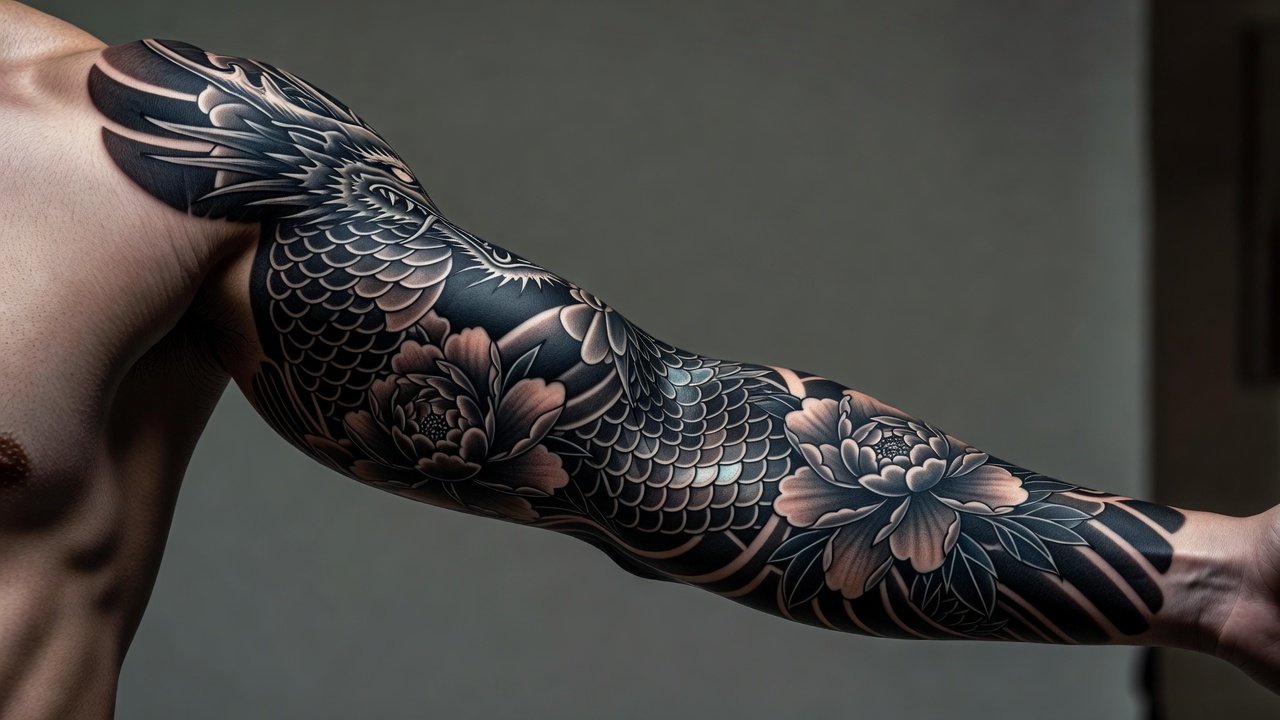
In 2026, tattoo artists and enthusiasts are increasingly turning to artificial intelligence to create intricate blackwork, photorealistic, and traditional irezumi designs. These styles demand precise shading, dense linework, and cultural motifs that blend seamlessly with human skin. AI tools accelerate ideation while allowing professionals to refine outputs into custom stencils that respect artistic originality and client skin variations. Unlike traditional hand-sketching, which can take hours or days per concept, AI enables rapid iteration across multiple variations. This article examines leading platforms, effective prompting techniques, real-world refinement examples, key limitations, and a complete workflow from digital concept to tattoo stencil. Tattoo professionals searching for modern design workflows will find practical comparisons and decision-making guidance throughout.
Leading AI Platforms for Tattoo Design in 2026
Several established AI image generators excel at body art styles. Midjourney and Stable Diffusion variants remain popular for their control over high-contrast blackwork shading. DALL-E 4 and Adobe Firefly offer strong integration with vector tools for stencil preparation. Each platform handles the fusion of dense black fills with realistic skin texture simulation differently. Midjourney stands out for its community-driven style references that capture the flowing energy of irezumi waves and mythical creatures. Stable Diffusion allows fine-tuned models trained specifically on tattoo portfolios, giving artists more predictable results when blending realism portraits into traditional motifs. Adobe Firefly integrates directly with Photoshop, making it ideal for professionals who need to export clean line art ready for stencil cutting. These tools support custom training on tattoo portfolios, helping maintain style consistency across sessions. Artists often combine outputs from multiple platforms to leverage each tool's strengths before moving into refinement stages.
Effective Prompting Strategies for Blending Styles
Successful prompts combine descriptive style keywords with technical tattoo parameters. A strong example prompt might read: "intricate blackwork irezumi sleeve on forearm, dense dotwork shading mixed with photorealistic koi scales, traditional Japanese motifs, high contrast, skin texture visible, 8k resolution, tattoo stencil ready." Advanced users layer negative prompts to avoid unwanted elements such as color bleed or overly cartoonish features. Weighting terms like (blackwork:1.4) ensures shading density. Experimentation with aspect ratios matching body parts (e.g., 9:16 for arms) improves composition accuracy. Additional strategies include specifying lighting conditions that mimic how tattoos appear under studio or natural light, and referencing historical irezumi masters to guide motif authenticity. Users should iterate prompts in small increments, testing one variable at a time such as shading density or motif placement. This methodical approach reduces revision cycles and produces concepts closer to final client expectations.
Real-World Examples of AI Concepts Refined by Artists
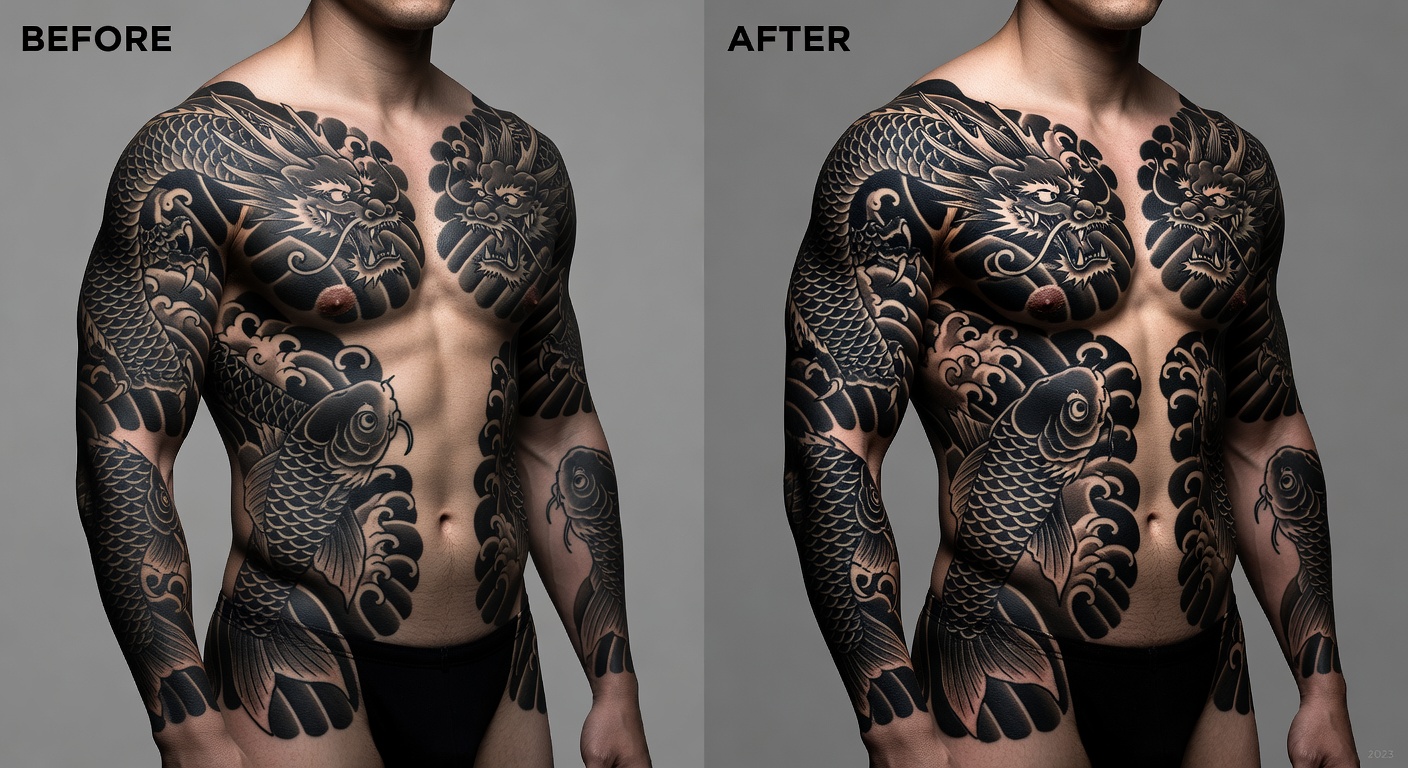
One case involved an artist generating 12 variations of a blackwork realism tiger irezumi piece. The AI produced base shading and motif placement in minutes. The artist then adjusted muscle flow lines and added subtle skin stretch details by hand, resulting in a design approved after two client revisions instead of the usual five. Another example merged photorealistic portrait elements into traditional irezumi waves. AI handled the initial layering; the tattooist refined gradients to match the client's skin tone variations, ensuring longevity post-healing. A third studio used AI to explore hybrid designs combining blackwork geometric patterns with irezumi cherry blossoms on a client's back. The generated concepts provided a starting point that the artist expanded with custom negative space planning, creating better visual flow across the spine and shoulder blades. These examples demonstrate how AI serves as an ideation accelerator rather than a final solution.
Limitations: Originality, Skin Texture, and Ethics
AI outputs often require significant artist intervention to achieve true originality. Generated designs may inadvertently echo existing flash art, raising copyright concerns. Skin texture simulation remains imperfect; AI frequently over-smooths pores or underestimates how ink settles in different skin types. Artists must always inject personal technique. Over-reliance can lead to generic results that lack the soul of hand-drawn work. Ethical use involves treating AI strictly as a collaborator rather than a replacement. Different skin tones and textures demand manual adjustments that current models struggle to predict accurately. Professionals also note that AI sometimes produces overly symmetrical compositions that feel less dynamic than organic hand sketches. Addressing these limitations requires ongoing education in both AI capabilities and traditional tattoo fundamentals.
Step-by-Step Workflow: From AI Output to Tattoo Stencil
- Generate base concepts using targeted prompts in your chosen AI platform.
- Export high-resolution images and import into vector software for line cleanup.
- Adjust scale to match client body measurements and curvature.
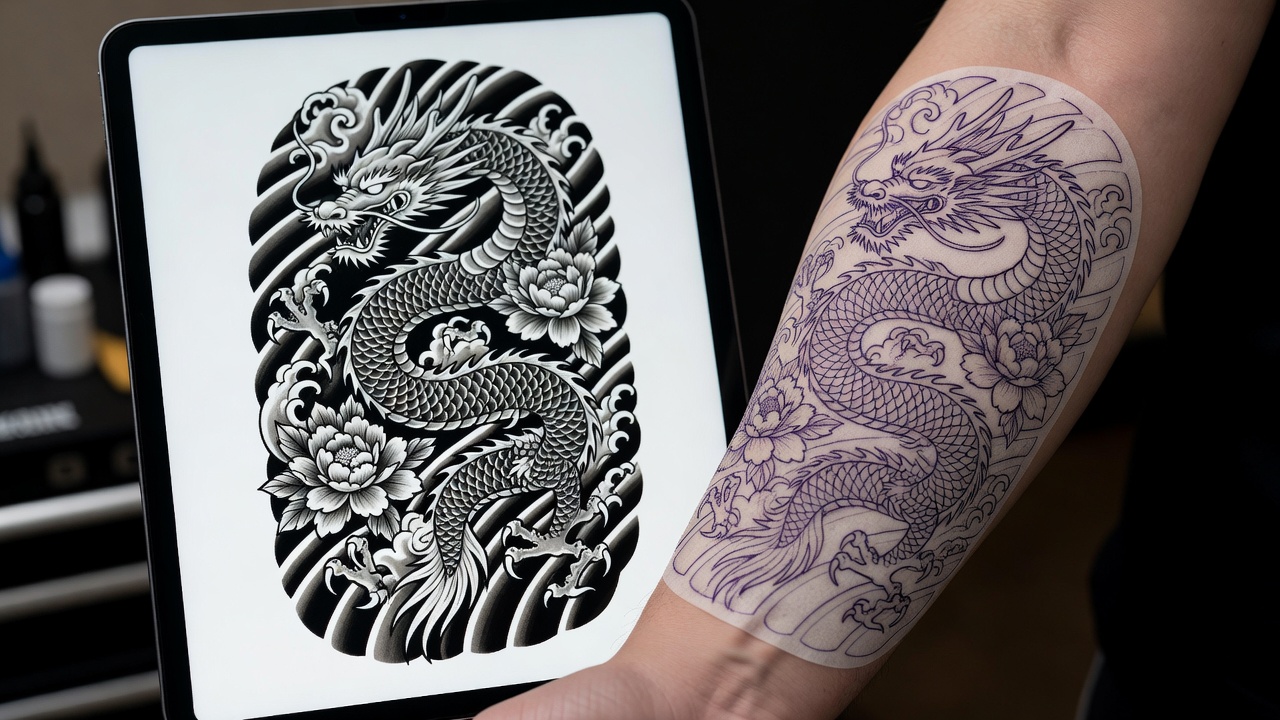
- Print test stencils on transfer paper and conduct skin mapping sessions.
- Incorporate client feedback and finalize with hand-drawn enhancements.
- Apply stencil and verify alignment under natural lighting before tattooing begins.
Each step benefits from documentation. Keeping records of prompt variations and refinement choices helps artists replicate successful techniques in future projects. Many studios now maintain shared prompt libraries tailored to blackwork and irezumi aesthetics.
Practical Comparisons to Hand-Sketching Methods
Hand-sketching offers unmatched tactile feedback and immediate customization during client consultations. However, it limits the speed of exploring stylistic hybrids like blackwork realism with irezumi elements. AI reduces initial exploration time by 70-80 percent, freeing artists for the creative refinement phase where human expertise shines. Many studios now combine both: AI for broad concept boards, hand-sketching for final client presentations. This hybrid approach improves satisfaction rates while preserving the craft's integrity. Hand-sketching remains superior for conveying texture through pressure variations that AI cannot yet replicate. Conversely, AI excels at generating dozens of compositional options that would take days to sketch manually. The most effective professionals use AI to handle repetitive elements such as background fills, reserving their energy for focal motifs and client-specific adjustments.
Copyright Considerations: Short FAQ
- Can I sell AI-generated tattoo designs? Ownership depends on the platform's terms and the degree of human modification. Always add substantial original elements.
- What about traditional irezumi motifs? Cultural symbols often fall outside copyright, but specific artist interpretations may not. Research sources thoroughly.
- How do I protect my refined designs? Document your modifications and consider registering original works via official channels such as the U.S. Copyright Office.
- Are there health guidelines for AI-assisted tattoo designs? Consult resources from the World Health Organization regarding safe tattoo practices and skin preparation.
Conclusion
AI tools are reshaping workflows for blackwork, realism, and irezumi tattoos without replacing the artist's hand. By mastering prompting, understanding limitations, and following structured refinement processes, professionals can deliver more innovative, client-specific results in 2026. The most successful outcomes always blend technological speed with traditional craftsmanship and ethical awareness. Tattoo artists who integrate these tools thoughtfully will stay competitive while maintaining the high standards their clients expect.
No comments yet. Be the first!